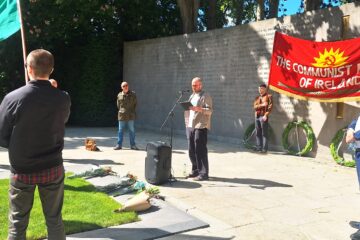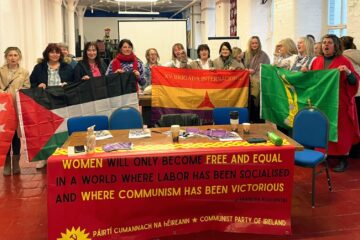
On 11th of July, Independent Dublin Republicans organised a commemoration for Irish Republicans who fought Fascism 1936 – 1938 in Spain. Comrade Gearóid Ó Machail spoke at this event; he is an Executive Committee member of both Friends of the International Brigades Ireland (FIBI) and the Communist Party of Ireland (CPI). Tet of his address and a video recording of it are available below.
A Chairde, A Chomrádaithe, A Dhaoine Uaisle
Ba mhaith liom ar dtús buíochas a ghabháil leis na Poblachtánaigh Neamhspleácha i mBaile Átha Cliath as an chuireadh labhairt anseo inniu. Is mór an onóir dom bheith i mo sheasamh ag taobh uaigh Frank Ryan anseo i nGlas Naíon i gcuideachta daoine atá tiomanta sa troid I gcoinne fascism in Eireann agus ar fud an domhain.
It is a great honour to stand here today, on this sacred ground in Glasnevin, to commemorate the 90th anniversary of the outbreak of the anti-fascist war in Spain. We gather at the grave of a true and revered Irish republican and internationalist, Proinsias Ó Riain, hero of the Irish Republican Army, the Republican Congress and leader of the Connolly Column of the 15th International Brigade in Spain.
Frank Ryan was a man of many ranks and titles, each earned through his unwavering commitment to the cause of working people. He was Adjutant of the Dublin Brigade of the Irish Republican Army, a member of the IRA’s ruling executive, and the editor of An Phoblacht. In Spain, he rose to the rank of Major and became Adjutant of the 15th International Brigade of the Spanish Republican Army. He was, as the historical record shows, the Commander of the Irish Unit in the International Brigades. He was a soldier of liberty, a true patriot who would be turning in his grave on this fine summer morning if he was to witness the tragic and ahistorical deployment of the term ‘patriot’ by the motley assortment of foreign-funded grifters who find common cause with reactionary British loyalism in England and the Six Counties..
But Brigadista Frank Ryan was more than a soldier. He was a man of profound culture, a passionate advocate for the Irish language. Born to national school teachers who instilled in him a deep grá for An Ghaeilge, he was devoted to its restoration as the national language from his earliest days. He studied Celtic Studies at University College Dublin, edited an Irish-language camp journal while imprisoned during the Civil War, and won the Cumann Gaedhealach’s gold medal for oratory in Irish. He wrote for Irish-language publications and even briefly edited An Reult – The Star. After university, he taught Irish at Mountjoy School here in the city andhe also edited An tÓglach for the IRA. His evenings were devoted to teaching Irish at Conradh na Gaeilge, lecturing in history and literature, and leading the occasional céilidh. His love for our native tongue was not a hollow nationalist affectation; it was a living part of his anti-imperialist, socialist and internationalist soul.
Today in Ireland, it is shameful to see our language and cultural symbols being hijacked by fake patriots and far-right forces, funded by anonymous donors from abroad, who seek to use our anti-colonial heritage to divide the Irish working class. The fascists wrap themselves in the tricolour and even quote the words of our republican dead to promote their alien, right-wing politics that represent everything Frank Ryan fought against. The racists are the inheritors of the spirit that sent General O’Duffy to fight for Francisco Franco. They are the enemies of the republic of workers and peasants that Frank Ryan and his comrades dreamed of and struggled for. ‘The fascists allies are the powerful and wealthy. Frank Ryan’s men came from the other side.’
We must reclaim our language and our history from these imposters and allies of reactionary British loyalism and fascism in England and the Six Counties. Frank Ryan’s Ireland was an Ireland of solidarity and socialist republicanism, not of division and hatred.
It was this internationalist spirit that led Frank Ryan, despite his deafness, to organise the first transport of Irish Volunteers to Spain in December 1936. About 80 men travelled with him, a noble band that would become known as the Connolly Column. Ryan himself declared the purpose of their mission in words that still ring with tremendous power today:
“We have come out here as soldiers of liberty to demonstrate Republican Ireland’s solidarity with the gallant Spanish workers and peasants in their fight against fascism.”
These were not mercenaries, grifters or foreign-sponsored adventurers. They were working-class men, republicans, trade unionists, communists and socialists who understood that the fight against Franco in Spain was the same fight they waged against oppression and poverty and against the ruling class and élites in Ireland.
It would be remiss of me while here in Dublin not to mention the Dublin volunteers who answered Frank Ryan’s call – republican heroes whose names we must never forget. Tommy Wood, a young Dubliner from a staunch republican family, was just 17 years old. He left for Spain with Ryan on 11 December 1936 and was mortally wounded just 18 days later at the Battle of Córdoba. He was the youngest Irish volunteer to die in the conflict. His story is a testament to the courage of Dublin’s working-class youth. On the centenary of the 1916 Easter Rising, FIBI paid homage to Tommy Wood and his Brigadista comrades with a solidarity tour of the Córdoba Front in Andalucia. It was a very moving experience to think of the sacrifices of young Irish republicans offering their lives to hold fascism at bay in another country.
Kit Conway was a company commander in the 15th International Brigade. A veteran of the Irish War for Independence, he was shot and badly wounded while leading a rifle charge over a hill in the Jarama Valley on 12 February 1937, and died that day. Again, FIBI honour and remember the fallen at Jarama every February when the Irish join with international comrades at the Jarama Battlefield where so many anti-fascist heroes lie beneath the Spanish soil.
Kit was a comrade to Dublin Brigadistas Jack Nalty and Dinny Coady, and they were jailed together during the Bacon Shop strike in 1934, showing the direct link between the labour movement in Ireland and the anti-fascist struggle in Spain. The Bacon Shops dispute is historically significant because it escalated from a standard union fight over poor wages into a militant, politically charged conflict involving the Irish Republican Army and the Republican Congress.
Coordinated bands of armed IRA Volunteers—acting in support of the strike—carried out simultaneous guerrilla-style raids on several Bacon Shops branches across Dublin. The strike and the subsequent armed raids triggered a severe crackdown by the Free State government. The day after the raids the Branch violently raided Connolly House, the headquarters of the Communist Party of Ireland, using the Bacon Shops attacks as justification to target left-wing organisations. The dispute serves as a prime example of the intense convergence of socialist politics, trade unionism, and militant republicanism in 1930s Ireland.
Brigadista Jack Nalty, a republican, socialist, and trade unionist from East Wall, was among the first to leave for Spain with Ryan in December 1936. He became a company commander. He returned to Spain after being invalided out and was the last Irish volunteer to die in combat, killed at the Battle of the Ebro on 23 September 1938. Though his body lies under Catalan soil, he is remembered in Glasnevin in his family grave, and FIBI has previously held ceremonies both here and in Catalunya with his family. Nalty was a core militant organiser who was arrested and imprisoned alongside prominent socialist republicans like Charlie Donnelly and Cora Hughes for aggressively picketing factories and shops.
The anti-fascist fight did not only play out on the battlefields of Spain. Here in Ireland, a brave network of supporters organised solidarity with the International Brigades. Among the many republican graves in Glasnevin is that of Hannah Sheehy Skeffington. This great feminist and socialist republican was a main organiser and chair of the Irish Friends of the Spanish Republic. She worked tirelessly to raise funds, support the families of volunteers, and campaign against the policy of non-intervention that was starving the Spanish Republic of the arms it needed to survive. Her work reminds us that the anti-fascist struggle was a fight for all of our society, led by both men and women.
The legacy of Frank Ryan and his comrades was kept alive by the dedication of comrades like the legendary Mícheál Ó Ríordáin. O’Riordan, who also fought with the Connolly Column in Spain and Catalunya, went on to found the Communist Party of Ireland, ensuring that the flame of revolutionary internationalism continued to burn in this country.
And we must pay tribute to the work of Eddie O’Neill and the Friends of the International Brigades in Ireland (FIBI). Eddie O’Neill, a true legend of the left republican movement, was the founding President of FIBI. His funeral ceremony took place here in Glasnevin before his ashes were scattered in Jarama and in his native East Tyrone. Eddie co-founded the Friends of Charlie Donnelly organisation with Brigadista Bob Doyle and Harry Owens, and it was transformed into FIBI to honour all the Irish Volunteers of Liberty who took the fight to the fascists in Spain. Eddie organised annual solidarity visits to the Jarama, Ebro, Córdoba and other battlefields and worked tirelessly to ensure that the sacrifice of the Irish Brigadistas would never be forgotten. His work, and the work of FIBI, is a vital thread connecting our past struggles to our present-day fight against fascism, racism and division of the working class.
Comrades and friends,
As we stand here in Glasnevin, surrounded by the graves of revered republicans and revolutionaries, we don’t need to be reminded that the fight against fascism did not end with the fall of the Spanish Republic in 1939. It did not end in Stalingrad in 1943 nor at the Battle of Berlin in 1945. It is a fight that continues today, everyday, in every street, every community and every workplace. In 2009 Brigadista Bob Doyle was given a tremendous funeral procession in O Connell Street from the Garden of Remembrance to Liberty Hall, led by a united front of republicans, socialists and anti-fascists of every hue. He had joined us the year before on his last visit to the Jarama Battlefield and the Basque Country where he was eager to remind us at the end of his rousing speeches that Lá lucha continúa!
Frank Ryan, Tommy Wood, Kit Conway, Jack Nalty, and all the volunteers of the Connolly Column showed us that internationalism is not a luxury in the struggle for freedom, but an absolute necessity. They showed us that the working class of Ireland has common cause with the working class of the world.
Let us honour their memory not with empty words and solemn ceremonies but with concrete and united action to defeat fascism. Let us also defend the Irish language and culture from those who would pervert and shame it in the service of their imperial masters. Let us stand in solidarity with workers and oppressed peoples everywhere. And let us build the workers’ republic that Frank Ryan and his comrades died for.
Críochnóidh mé trí cuireadh a thabhairt daoibh go léir chuig comóradh 90 bliain Chath Jarama i Maidrid an bhliain seo chugainn. Leanfaidh FIBI de chuimhne Frank Ryan agus an Colún Connolly a úsáid chun inspioráid a thabhairt don chéad ghlúin eile de ghníomhaithe frith-fhaisisteach sa streachailt fhada atá romhainn.
I shall finish by inviting you all to the 90th anniversary commemorations of the Battle of Jarama in Madrid next year. FIBI will continue to use the memory of Frank Ryan and the Connolly Column to inspire the next generation of anti fascist activists in the long struggle ahead.
Beidh an lá linn. No Pasarán!